The ROI of resilience: How Crossroads Safehouse & Services is strengthening Larimer County’s behavioral health workforce
A look at the organization’s multi-pronged investment in domestic violence victims, youth and staff
Investing in behavioral health isn’t just a moral imperative – it’s an economic one. At Crossroads Safehouse & Services, Larimer County tax dollars are doing more than funding youth prevention and domestic violence victim advocacy; they are stabilizing the very workforce that makes healing possible.
In an industry rife with staff shortages and turnover, Crossroads Safehouse & Services is using a portion of its Behavioral Health Services Impact Fund grant to treat staff wellness as a core pillar of care. By providing therapy reimbursements and a dedicated calming space, the organization is aiming to keep its skilled professionals in the field, thereby increasing community access to care.
Sinclaire Vandervoort represents the human face of this investment. Joining Crossroads in 2021 as a part-time employee, she hit the wall of secondary trauma common in human services.
The introduction of staff mental health benefits didn’t just offer her a lifeline – it offered her a pathway to growth. Instead of exiting the organization or field, she felt empowered to stay and eventually step into her current role as direct service manager.
“That changed everything for me,” Vandervoort said.
“Putting together a care team for myself – it didn’t just allow it to sustain me. It made me want to be part of the community and do that for others. It really represents this community of care that we can really be stewards with.”
Looking deeper at the investment
On a recent day in April 2026, Executive Director Lori Warren led the way through the renovated Crossroads Safehouse & Services building in Fort Collins. Once inside the secure facility, visitors are welcomed by a colorful mural of hands holding flowers tended by bees. This is the new HIVE, or Hub for Information Validation & Empowerment.
It is a space where domestic violence survivors can seek not only respite in the safehouse but also connect with multiple agencies for legal counsel, medical care, food, clothing, housing and more.
Warren is proud – of the capital campaign that made it possible, the complexities co-located organizations navigated to be part of The HIVE, and of this defining moment in Crossroads’ history.
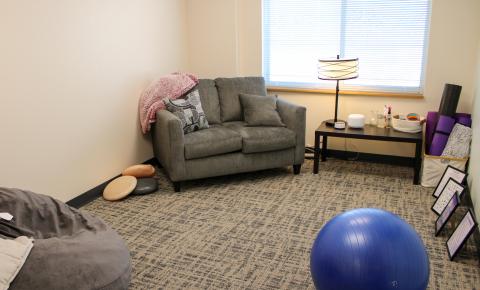
Around the corner from The HIVE mural are two rooms: a calming space for staff and one for Crossroads clients. Both exist because of Impact Fund grant dollars.
The client room has a calming feel, with neutral walls, warm light, cozy furniture, and a little table for children. It is a private place where clients can be alone, meet with a therapist, or take phone calls related to their court cases.

Yoga mats, an oversized bean bag chair, and sound machine are some of the items staff will find in the room they have 24/7 access to (much like the safehouse). Investing in the room, as well as therapy reimbursements, has created stability on a team that does vital but traumatizing work, Warren said.
“I think it has helped with resilience and healing,” she said during an interview in fall 2025. “It’s the ability to come back and show up the next day.”
About two years ago, staff members experienced grief and loss following a client’s death. One staff member particularly close to the client said they could not continue to work. After receiving care themselves, however, things shifted.
“They said, ‘I would not be here today. I wouldn’t have had the money to process that,’” Warren remembered the staff member sharing.
How Crossroads invests these tax dollars has evolved. The organization initially paid for staff to see a designated therapy provider but learned that not everyone heals the same way. This was the impetus for the therapy reimbursement program and staff calming room.
Behavioral Health Services partners with grantees to set realistic and specific outcomes for their grant-funded work. It is also understood that outcomes may shift, once grantees learn more about their clients’ specific needs and how services are received within the communities they serve. Not all funders operate in this manner.
“I appreciated the flexibility of these funds,” Warren said, later adding, “We weren’t penalized for not knowing. We were allowed to grow and evolve.”
Community impact
As one of BHS’ longest-standing grant recipients, Crossroads Safehouse & Services has received $420,723 in multiple annual grants since 2019, when the Impact Fund started.
In addition to the calming rooms and staff therapy, Crossroads also used Impact Fund dollars during the 2025 grant cycle to provide support groups for 50 victims of domestic violence and their children, tracking the number of participants who report an increase in knowledge about how to plan for their safety, as well as the myriad community resources available to support them and their families.
The organization also continued its investment in the Time to Talk prevention education program. Poudre School District middle and high school students report being able to recognize the signs of an abusive relationship and knowing how to help someone experiencing teen dating violence, based on pre and post-test results.
Camille Vandergriff, Crossroads youth prevention coordinator, said about one in three teenagers will experience dating violence. Upon starting in the role several years ago, she was pleasantly surprised to see how seriously the students and trained peers took the topic.
As part of the program, students learn about six types of abuse: verbal, emotional/mental, physical, sexual, stalking, and financial. Staff learned through discussions that “technology abuse is (also) a massive form of abuse that teens experience.” Examples include sending text messages that are threatening and then deleting them, or someone demanding that you share your device’s location with them.
Beyond the benefits of providing preventative education at the schools, Vandergriff added, “We’ve had lots of students reach out to us over the years for support.”
Like other providers and clients, Vandergriff and her colleague Megan Harvey, Crossroads outreach and prevention manager, BHS asked: What does it mean to you to live in a community that values behavioral health so much that voters approved a tax to support it?
For one, their work wouldn’t be possible without the Impact Fund grant, Vandergriff said.
Harvey added: “I always talk about how lucky we are to be in a community that does care about the people. … The fact that we can all agree that it’s important to take care of each other, it feels so good to be here.”
When we invest in the healer, the whole community heals. By prioritizing staff mental health, Crossroads Safehouse & Services is transforming a cycle of turnover into a pipeline of leadership.

Crossroads Safehouse & Services
Crossroads provides emergency safehousing, advocacy, legal assistance, rapid rehousing and crisis intervention for victims of domestic violence.
- 24/7 Helpline: Call 970-482-3535
- Email: info@crshs.org
- Website: https://crshs.org/
New! The HIVE (Hub for Information Validation & Empowerment)
- Phone: 970-851-9929
- Email: TheHIVE@crshs.org
- Hours of operation: 10 a.m. to 6 p.m. Monday, Tuesday, Thursday
- Located at Crossroads Safehouse & Services: 421 Parker St. in Fort Collins
Madeline Novey
Communication Coordinator
Behavioral Health Services
970-619-4255
noveyme@co.larimer.co.us

