Harvest Farm recovery program having long-term, positive impact in Larimer County
Participants graduating at record rates; 93% remain in stable housing a year later
Editor's Note: The Denver Rescue Mission announced that Harvest Farm will close at the end of June 2026. The organization's new homeless resolution center in Fort Collins is expected to open Jan. 1, and will include recovery support services and many of the programs currently offered at Harvest Farm.
Turning east onto dusty County Road 66 in Wellington, Colorado, Jorda didn’t know what to expect of his first experience in a recovery program. What he found at Harvest Farm surprised him.
“Pulling in, you’re greeted by Charlie the llama,” a white and gray, wooly camelid who strides up to the fence near the front office and makes friends with those who stop to visit – or simply park nearby.

Then, about 15 to 20 staff and program participants formed an impromptu line and introduced themselves to the 26-year-old Larimer County resident. Behavioral Health Services is using only first names of participants to protect their privacy.
“It was very, very, very welcoming,” he said, and a stark contrast to the institutional recovery center he imagined. So he settled in for the journey ahead.
“I just showed up and trusted God to take the wheel.”
Jorda is one of 75 men who, as of mid-October 2025, live and work on the 100-acre farm and recovery center operated by the Fort Collins Rescue Mission, under the umbrella of the Denver Rescue Mission.
As part of the New Life Program, men focus on breaking the cycles of addiction, homelessness or both. Over the course of nine months to one year, they receive counseling, develop critical life skills, obtain sustainable housing and jobs and, generally, find solace in life and work on the farm.
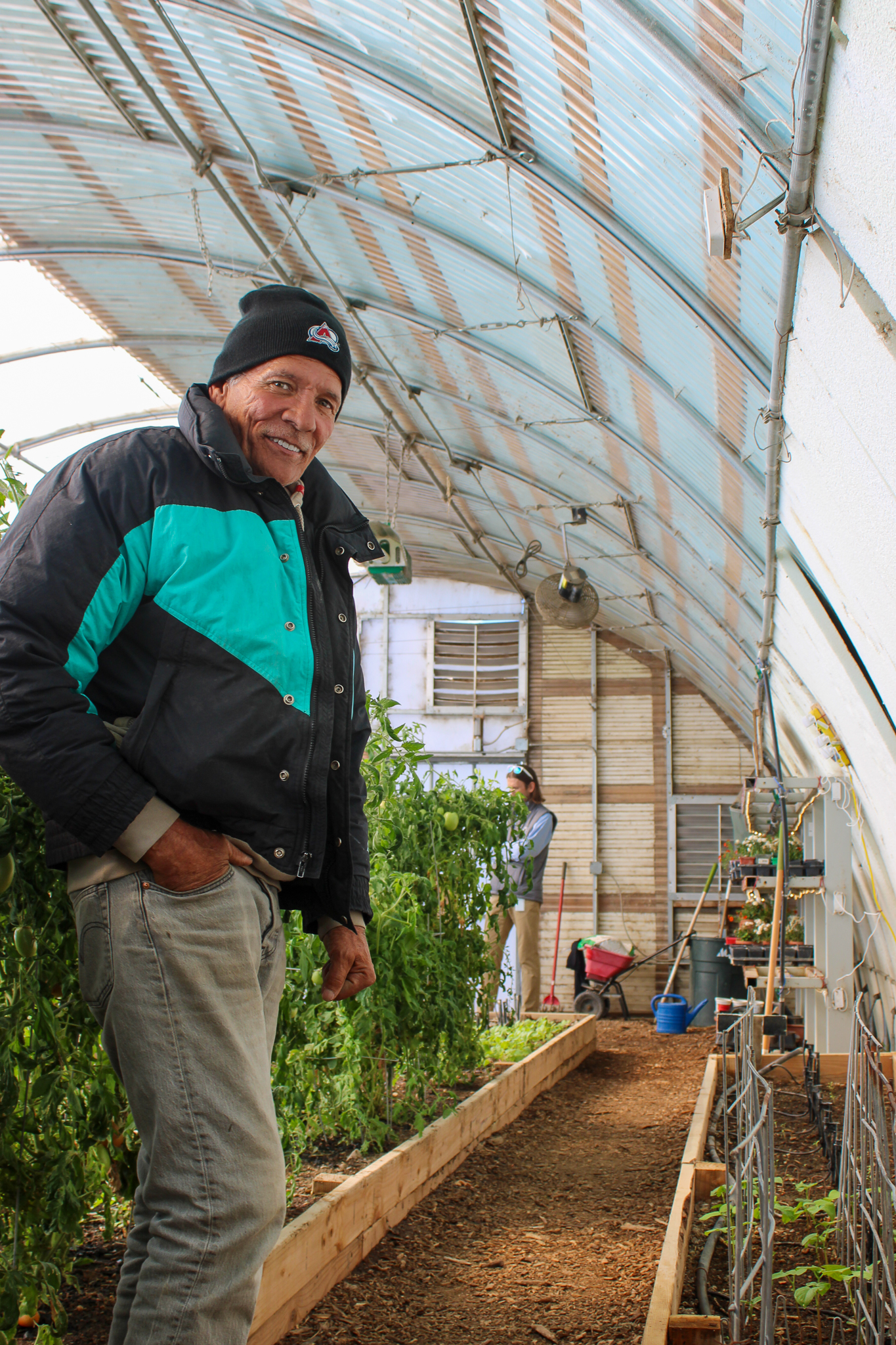
“It does work. This place works,” said Roger, who took a break from tending to grapefruit, green beans, tomatoes, peppers, and onions in the greenhouse to share some of his story. “This is a good place for anyone who wants to straighten up.”
Roger, 62, had been to rehabilitation, or “rehab,” three times in his life before he found “the farm.” Through those stints, he learned the typical 30- or 60-day programs weren’t enough. He needed something more – something like Harvest Farm – to get sober and start to heal.
Substance-use disorder, or addiction, doesn't discriminate based on age, race, spirituality or income. Jorda and Roger are two among about 40.3 million people, ages 12 years and older, who reportedly have a substance-use disorder in the U.S., national data show.
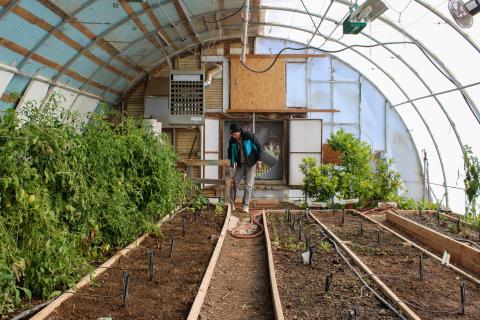
“This program is good therapy,” Roger said, reflecting on his two months at Harvest Farm thus far. “If you can get through this, you can get through anything.”
The ‘why’ behind the work
Anyone who tours the farm with Kyle McPherson, senior director for Northern Colorado, can tell he is deeply invested in the people he serves and the broader community.
On a windy October afternoon, he talked with an almost reverence about the men of Harvest Farm, as well as the staff, whose work started roughly 35 years ago.
Wellington had no stoplights and talk of addiction was taboo when the Denver Rescue Mission purchased the rural property, located about 70 miles from its city-based shelter. All of that made it “incredibly ambitious” and “visionary,” McPherson said, for the Mission to buy the farm, intending to provide recovery services there for those experiencing homelessness.
Although it’s not a requirement to be in the program, being without permanent, stable housing is something many of the men have in common.
“I was definitely drinking myself to being alone and on the street,” said Jorda, who feels blessed that it didn’t become his reality like so many of his Harvest Farm roommates.
“The amount of fear they have is absurd,” he said, from surviving with no food for days at a time to being robbed of all their belongings.
As he has listened to and learned from others, Jorda said those experiencing homelessness and addiction: “They’re all just people.” They are healthcare workers and members of the military, like him. They are neighbors and spouses, CEOs and frontline workers.
“You are all one bad paycheck or bad happenstance from being homeless,” he said.
Leah Guerrero, case management supervisor with Harvest Farm, said it’s a common misconception that being homelessness or having an addiction is “a choice.” In reality, it’s more complicated.
The science of addiction tells us a person’s desire for drugs or alcohol vastly outweighs their desire for even food or water. That substance use over time fundamentally changes the brain, as explained in this Changing Minds Larimer campaign video, and cravings can continue for even two years after a person is in recovery.
On top of that, other factors may come into play.
Every man at Harvest Farm takes an Adverse Childhood Experience (ACE) assessment that looks at the number of stressful or traumatic events (called ACEs) experienced by children under the age of 18. These go beyond normal life stressors and include things like abuse, neglect, witnessing violence, or having a family member with a substance-abuse disorder. The more ACEs a person has, the greater their risk for chronic health conditions, mental illness, and substance abuse in adulthood.
The highest possible score is 10 out of 10. Among the 75 men currently at Harvest Farm, the average number of ACEs is six.
“These are kids who were abused and terribly treated,” McPherson said. “We’re just trying to give these kids the love they deserved.”
Life at Harvest Farm
What makes Harvest Farm’s New Life Program unique – aside from its plethora of pigs – is the lack of a price tag. Because there is no cost, thanks to donations and grants, the farm becomes a real option for men who can’t afford alternatives.
The length of stay at an inpatient rehabilitation center varies but is typically 30 to 60 days; depending on the location, length of stay, and center, the cost can range from $5,000 to $80,000, according to the American Addiction Centers.
“It makes it significantly easier for people to get the help,” said Guerrero.
During their stay at Harvest Farm, men do individual and group therapy with clinicians on-site and can meet with a psychiatrist for medication management. They attend Alcoholics and Narcotics Anonymous meetings, and are rooted in the community through sober activities, from Bible study groups to knitting clubs. In some cases, they get to do things they never have before – even as children –, like playing mini golf.
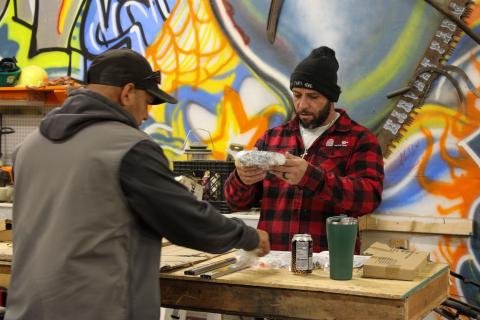
“Caring for a creature has intrinsic value,” said McPherson, and can be therapeutic. Not long after he said this, one of the men chased down a loose piglet and returned it to its pen – much to its chagrin.
After about two months at the farm, the men partake in a 10-week course, where they learn about anger management and self-awareness, build strong resumes, and how to budget and eliminate debt. These skills are key to the community-based work component of their recovery, during which they get a job and save money for housing after they leave Harvest Farm.
As a results-based program, each man must meet four criteria to graduate:
- Have income sufficient enough to support themselves,
- Be rooted in the community,
- No longer engaging in destructive habits, and
- Have stable housing
Graduations have spiked in recent years, McPherson said, quickly pulling data up on his phone while riding shotgun on a driving tour of the farm. There were 39 graduates in 2021, 46 in 2022, 45 in 2023, and 78 in 2024. Notably, 93% of those men remain housed a year later.
So what’s propelling their success?
The return on Larimer County’s investment
Multiple things may have contributed to the increase in graduation rates. For one, program participants are getting therapeutic interventions – think of any strategy designed to improve a person's mental, emotional, or physical well-being – earlier into their stay at the farm.
But one thing, in particular, stands out: the farm’s growing peer support program.
Peers are people with shared lived experiences – such as living with a mental illness or recovering from substance abuse – who provide emotional, social, or practical support to others going through something similar. In the case of Harvest Farm, they are six men who graduated from the program and chose to stay longer to support others in their recovery.
“I think it’s beneficial to see hope and progress,” Guerrero said.

The peer program started with three men who agreed to live in a designated house on the farm and serve as peers, meeting one-on-one with men and leading groups. To their credit, they advocated to make room for more peers by sharing space in the house.
The program is made possible, in part, through the Larimer County Behavioral Health Services Impact Fund Grant Program, which has distributed $17.7 million to 77 unique organizations in the past seven years. Larimer County awarded $100,000 to Harvest Farm in the 2025 grant cycle for peers to receive specialized training.
“We would not have started this program if it weren’t for Larimer County,” McPherson said, adding later, “It’s not lost on us the impact of this funding.”
Jared Caddell went through The New Life Program twice before he was ready to get sober. When he decided it was finally time to change, he returned to Harvest Farm during the COVID pandemic and graduated.
His heart and passion is in supporting “others going through it,” and he started as a program coordinator, working overnight and weekend shifts on the farm. Today, he’s come full circle and serves as the associate director of programs.
The broader public view of those in recovery is “still a stigma of broken addicts. They view them as lost causes,” he said.
“I view them as exactly the opposite. I think they’re some of the strongest people. They may be a little broken when they come in, but then they build confidence and start giving back.”
Caddell is responsible for selecting peers through an application process that’s becoming more and more competitive, as more men want to take part.
He looks for guys who want to do it for the right reasons and are committed to being a stable role model, sharing knowledge about addiction and recovery, time management, interpersonal skills, finances, their relationship with God, and more. Last year alone, the peers helped 55 men get jobs after hours of interview coaching and resume building.
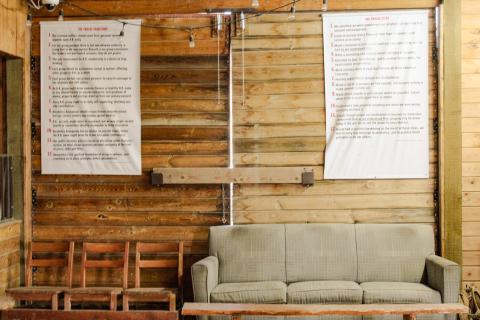
By investing behavioral health tax dollars in the peers – and all men at Harvest Farm, by extension – Caddell said recidivism goes down, men learn to be self-sufficient, and they become better people in society. This leads to lower rates of homelessness, substance use, and crime, he said.
Asked about moments that stand out, Caddell said he recently saw a daughter jump into her dad’s arms after a long time apart. Doing this work also means that people get their fathers, brothers, sons, employees, and friends back.
“That impact on society as a whole is huge,” Caddell said.
Who can receive care at Harvest Farm?
Harvest Farm accepts men from anywhere as long as they qualify and are in need of services. Staff embrace the belief that each person is special, despite his place in society or state in life, and treat participants with decency and respect.
To qualify for the free, donation-funded New Life Program, participants must be:
- At least 18 years old,
- Free of sex offenses and arson convictions,
- Physically able to work and walk a minimum of 3-5 miles a day,
- Not allowed to utilize nicotine products involving a flame or ember (i.e. no cigarettes, cigars, pipe tobacco). However, nicotine is allowed via e-cigarettes (vape pens), nicotine pouches, chewing tobacco, etc.
- Comfortable participating in a Christian program,
- Willing to submit to random drug and alcohol testing,
- Willing to commit to 5-9 months of residential care,
- Serious about making life changes, and
- No cell phones allowed for the first 30 days of the program.
Address: 4240 E. County Road 66 in Wellington, Colorado
Phone: 970-568-9803
Website: fortcollinsrescuemission.org/who-we-are/locations/harvest-farm/
Madeline Novey
Communication Coordinator
Behavioral Health Services
970-619-4255
noveyme@co.larimer.co.us

