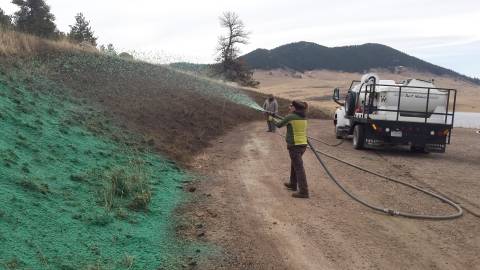
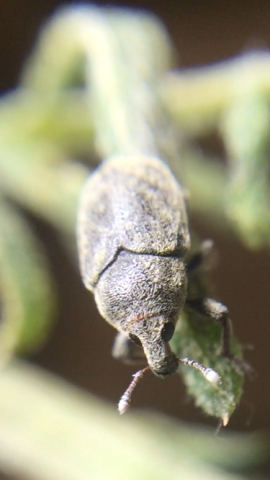
The goal of biological control is not eradication but the use of living agents to suppress vigor and spread of weeds. Such agents can be insects, bacteria, fungi or grazing animals, such as sheep, goats, cattle or horses. Grazing produces results similar to mowing. Biological control is most commonly thought of as "insect biocontrol".
The United States Department of Agriculture - Animal and Plant Health Inspection Service (APHIS) is the federal agency responsible for authorizing the screening and importation of biocontrol insects. APHIS conducts intensive multi-year screening programs assuring an insect agent's host specificity (feeds only on target weed species, not other plants) prior to approval for release.
Insect agents, proven to be effective, are utilized in cases where eradication is impractical due to the vastness or inaccessibility of an infestation, and where other methods of management are not feasible. Insect agents typically require 3-5 years for establishment and can limit the spread and density of target weed species by feeding on leaves, stems, roots and/or seed heads. Eradication of a weed cannot be attained through insect biocontrol. The most effective scenario is a weed infestation reduced to a "tolerable level", a level where the insect agents are significantly limiting distribution and abundance of the target weed species and the weed density is no longer considered detrimental to the desired plant community. Some biocontrol insects proven to be successful in certain areas of Larimer County are:
- Bindweed mites – field bindweed
- Flea beetles – leafy spurge
- Mecinus janthiniformus – Dalmatian toadflax
- Larinus minutus and Cyphocleonus achates – diffuse knapweed
For more information on insect biocontrol and to obtain insects, check out the Colorado Biological Pest Control Program or call the Colorado Department of Agriculture Insectary in Palisade, Colorado, at (866) 324-2963.